“…on Mt. Vesuvius broad sheets of fire and leaping flames blazed at several points, their bright glare emphasized by the darkness of night.” – Pliny the Younger in a letter to Cornelius Tacitus
February 5, 62 A.D., Pompeii, Italy – The earthquake started with a small rumble, as they often do, but it became a much bigger problem in short order. A great number of buildings in Pompeii and nearby Herculaneum were destroyed by the 7.5 magnitude event. A tsunami also hit Ostia, the port of Rome, and many ships, containing grain for the cities inhabitants, were lost.
Rioting followed after people panicked and worried whether or not they would starve to death. The issue was settled once Emperor Nero finally opened the storehouses of grain in order to ration supplies. Re-building, in Pompeii, Herculaneum, and elsewhere would take a great deal of money and time and the repairs were still ongoing by the time a larger disaster hit 17 years later. This earthquake had merely been the precursor to the event that would eventually make Pompeii famous the world over.
August 24, 79 A.D. – Ash and fire are falling from the sky. Vulcan’s wrath has opened the mouth of Vesuvius and chaos erupts in a frenzied exodus from the city. People literally flee for their lives, and it’s a good thing they are – as running away saves most of the population. Although, none of them will ever lay eyes on their beloved city again. Contrary to popular belief, most of the people in Pompeii, Herculaneum and the surrounding areas were able to evacuate and escape death. In Pompeii, of the estimated 12,000 to 16,000 inhabitants, only 2,000 people were believed to have been killed. Perhaps these men and women were stubborn, or sickly and old. Maybe they were injured and couldn’t walk very good. One thing we know – the intense heat killed all who remained. Superheated ash incinerated people on contact with their skin. Cadaveric spasms, stiffening of the body at the time of death, caused the bones to bend in the hands and feet. The ash covered these charred skeletons resulting in a surprising effect, only appreciated over 1,600 years later.
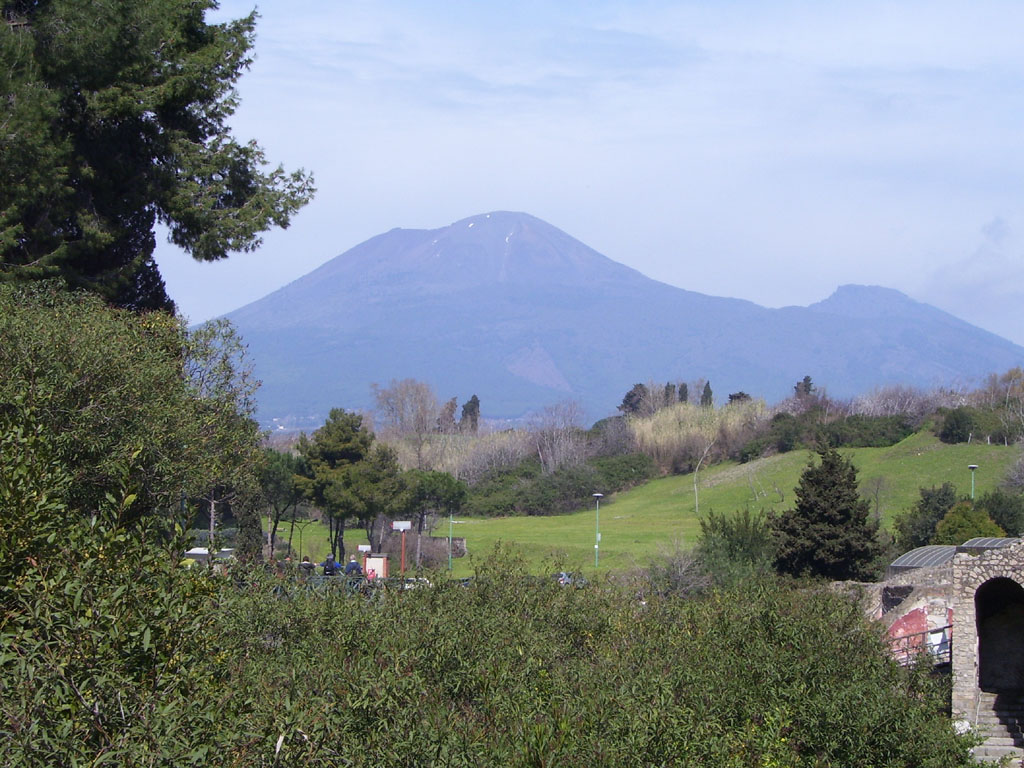
Vesuvius may have done its damage, but as it remains, so does Pompeii endure to tell of its destructive power.
1599 – While digging an underground channel to divert the Sarno river, workers run into ancient walls covered with inscriptions and paintings. The architect, Domenico Fontana, is called and he makes the decision to simply cover everything up again. Most history classes don’t bother to mention him.
1738 – Herculaneum is discovered during another construction project, this time the digging of a well. A number of statues were found, eventually leading to the discovery of the whole city. The king, Charles III, was sought to obtain permission for further excavations, and the all important monetary contributions only he could provide.
1748 – Intentional excavations, while digging for a good spot to build a summer palace for the king, result in the official, not covered up, rediscovery of Pompeii. The man credited with the discovery is Spanish military engineer Rocque Joaquin de Alcubierre. Future historians agree that his name is long and hard to pronounce. He will be, sadly, forgotten despite his importance to history.
2006 – The mid-morning sun touches the tops of ancient houses as the city of Pompeii first comes into view. There are pathways, alcoves, staircases, mighty pillars, frescoes and other such things left to discovery on the stone-covered road ahead of me. There was a time when I never expected I would find myself there, but that thought has been pushed out of my mind forever. It has taken 3 hours by bus to reach Naples, where Pompeii lies in the shadow of Mt. Vesuvius, responsible for its burial under 13 to 20 feet of ash and pumice all those years ago. I stare into a window of the past, and what I see is incredible to behold.

The presence of the solar panels is nicely juxtaposed with the ancient buildings of Pompeii. Its a nice meeting of different eras in history. What the panels are powering, I’m not sure.
I’m here with my sister, mother, and a small tour group taking it all in. The hotels in Rome offer quite a few trips that provide transportation and when you get the chance to visit Pompeii, a city older than any place I’ve ever been, the only word you can speak is “yes.” Different groups get special access to certain areas not available to other groups, aside from being able to tour the entire city, and ours is taking us into the building with the rounded room you see in the picture above. We are told that this is the entryway to a Roman bathhouse. The walls of which, happened to be covered in drawings of stick figures engaged in activities we can’t immediately identify. The tour group points out that they are fornicating. We’re looking at 1st century porn. The existence of more sophisticated pornography was to elude the world for a millennia at least.
Leaving here, we walk through a large stone entryway up a road into the larger city. It stretches for miles beyond what I can see. Its intimidating and awe-inspiring at the same time. Humbling too. The obvious evidence of the previous devastations surrounds us. Vesuvius looms in the distance, ever present. The great mountain sleeps with no hint as to when it may wake again. I hope the moment doesn’t come soon as there is much to be learned from such an advanced series of ruins. Archaeologically rich, its been studied and dissected for centuries, its secrets revealing themselves over time, however slowly. I walk through an open forum, where short pillars are lined up in a row. In its day, each one of them would’ve had a product on it and a person trying to sell it to you. Like an ancient mall, with similar crowds.
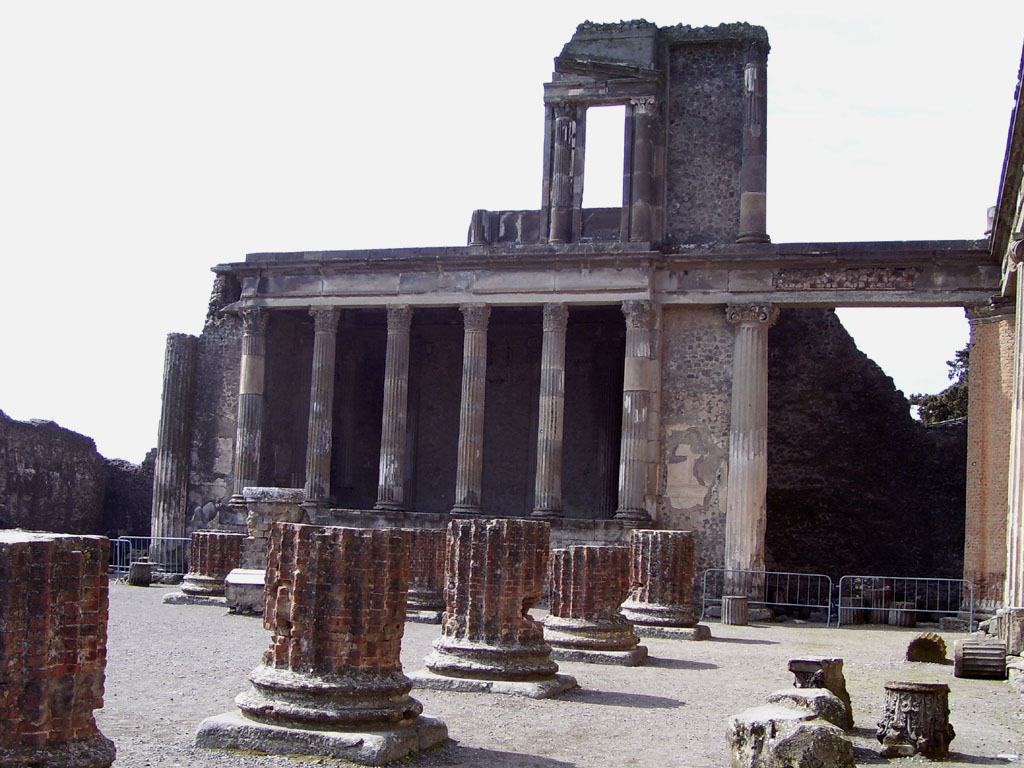
The basilica at the forum
In the distance, thousands of people, perhaps more than even the number of bodies eventually recovered (over 1,100 based on what I’ve read) roam and take pictures of the site. I wonder how many of the original inhabitants realized they would die, or thought the Roman gods would save them. Salvation was a pipe dream, and too much to hope for in their case. However, some of the bodies have taken on an interesting new life. As the ash and debris covered the bodies it also preserved them in a way. As the city was buried the places where the bodies lay created air pockets around which molds of the corpses were formed and left impressions in the earth. The first person to realize this (or perhaps the first one to do anything about it) was Italian archeologist Giuseppe Fiorelli (1823-1896) who directed the excavations at Pompeii from 1863-1875. He realized that although the bodies would’ve decayed long ago, the impressions of them that remained could be extracted from their holes. The hollow spaces were filled with plaster of paris and, once it hardened, the mold was removed from the ground. The ash was then removed, creating a plaster sculpture of the person at the moment of their death. I saw one of these for myself inside a small crowded building somewhere in the middle of the city. The cringing figure seemed to know it was dying, although its more likely they were already dead when their bodies were unceremoniously buried by the ash and pumice covering the city. It was strange, and very sad, to look at.
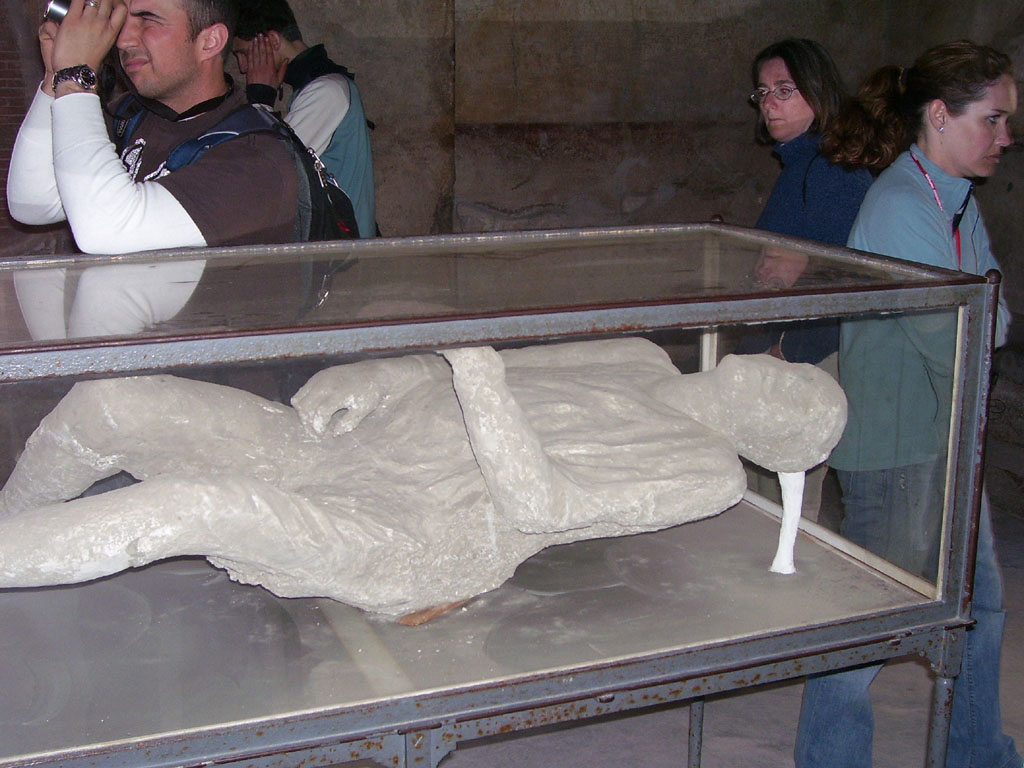
Tourists are taking pictures of everything in their line of sight, but for me, there was only one thing in this room worth focusing on.
We went on to see ruined buildings and some that were more intact. There were nice frescoes and paintings everywhere. The fact that the city was buried meant that air and moisture didn’t get in to the spaces occupied by these artistic flourishes. There was even some graffiti in a few places, celebrating the victories of gladiatorial champions. There were stone temples and old houses. One of them had a painting of exotic animals glimpsed in distant lands. A long time before the advent of photography, people were forced to get creative.
After leaving an amphitheater we spied the gladiator barracks and training green. This is where the aspiring warriors would train with swords, tridents, maces and whatever other ancient weapons struck their fancy. Some would die, but more often than not they survived. It would be foolish to let money-making entities perish without getting as much coin from their battles as possible. The warrior who lost a battle in the arena was often spared and lived another day to regain their lost glory.

The streets of Pompeii
I will never forget the warm spring air in Pompeii. The ancient streets, and crumbling pillars. The quiet beauty in the emptiness. I hadn’t just walked through a museum, or seen a TV show detailing the history of the city. I had walked its streets myself. Seen how the people lived, and how some died there too. To date, it remains in a state of continuing excavation and preservation. There are parts of the city left to be discovered by later generations, to see what they can learn from the past and to record it for posterity. The walls are fragile, and the buildings could crumble at any moment. But the memories, and writings of many people over the years have served to fill the hollow spaces left behind. As things once lost are found and Pompeii is brought back to life. – J

Ancient art show
 Splintered Kernels